what can be used to determine existing nonsocial and social reinforcers
Step 2 Implementing PRT


This stride puts together individual PRT components to create a PRT learning opportunity. The steps for using PRT include selecting target behaviors and varying tasks and responses.
Footstep 2.1 Select target behaviors
Select your targets from the toddler'southward individualized goals and objectives.
a. Determine the specific responses to prompt
Vary tasks. While following the toddler's lead, parents and practitioners should vary tasks, materials, and activities to maintain their toddler'due south interest and engagement. Mix up the activities and the tasks within activities. You lot should be alert to a toddler'due south behavioral cues (e.grand., lack of attention, attempts to modify activities) that indicate that they are becoming bored and that information technology is time to modify to a new item or action, or modify the tasks and demands within an activity. It is best to vary the task before the toddler disengages, so that motivation can exist sustained.
Target response variation. If appropriate, mix up the skills. Varying the target responses helps maintain a toddler'south level of responding and initiating during learning interactions. Varying targeted responses also helps avoid "drilling" the toddler. If attempting to ameliorate a toddler'due south motivation to appoint socially and larn, avert drilling by varying the target responses. Again, be alert to a toddler's behavioral cues that signal that they are becoming frustrated or bored and that it is time to vary the targeted responses.
Mix up the instructional cues, prompts, and contexts. Increasing the variation in cues and prompts for a task, and other environmental conditions, too helps to link desired responses to a diversity of antecedents and contexts that could exist present in a toddler's everyday environments. An instance would exist: education colors on a variety of child preferred stimuli during a variety of games in different rooms of the house. This increment in variation allows for the possibility of greater spontaneity and generalization across the initial learning situations and fosters the toddler's responsiveness to a range of stimuli.
b. Intersperse maintenance and acquisition tasks
Y'all tin maximize a toddler's motivation during learning and interaction by mixing maintenance opportunities with acquisition opportunities. The conquering trials involve tasks that are new or currently beingness learned and are frequently times more hard trials than previously mastered items in maintenance trials.
Identify
Identify skills that are like shooting fish in a barrel for individual toddlers (i.east., maintenance tasks) and ones that are more hard (i.e., acquisition tasks).
Mix
Provide a mixture of easy and more than difficult tasks so that toddlers can exist successful at using a variety of skills.
Build momentum
To facilitate maintenance of previously learned target skills and to build behavioral momentum for good trying on harder tasks, provide a few curt requests that are piece of cake and within the toddler'southward current repertoire of mastered skills to complete followed past 1 or two requests that are slightly more difficult for the toddler to complete.
EXAMPLE
A parent might enquire a toddler to point to a familiar moving-picture show in a favorite book (a maintenance task), and then ask them to identify a less familiar motion picture, or perhaps past request what is happening in the flick.
This is an acquisition task targeting verbs.
By attending to a toddler's behavioral cues that point that adding maintenance tasks prior to the adjacent conquering task might help optimize the toddler'south motivation to learn and socially engage, the ratio of maintenance and conquering tasks tin can be varied.
The toddler's behavioral cues might include: lack of attention, avoidance responding, escape-driven challenging behavior, lack of trying, and indications of frustration.
Pace ii.2 Identify learning activities and stimuli
a. Follow the child'southward lead
Following the toddler's lead in order to identify child-preferred pedagogy materials or activities and natural reinforcers is an important component of establishing motivation in PRT. This step allows toddlers to choose play materials, toys, and activities that will exist used in the PRT learning opportunity.
- Begin following the child'due south lead past observing when the toddler has costless access to materials and activities to identify their preferences for items, activities, and toys. Entice the toddler with toys and activities and detect how they toddler responds in order to assess if, in that moment, they are interested in playing with the materials or engaging in the activeness.
- If the toddler indicates interest in the moment, then the item or activity tin can exist used within the PRT learning opportunity.
A toddler might indicate interest by reaching for the materials, begining and playing with the materials, or by smile and giviing eye contact during the social activity.
Example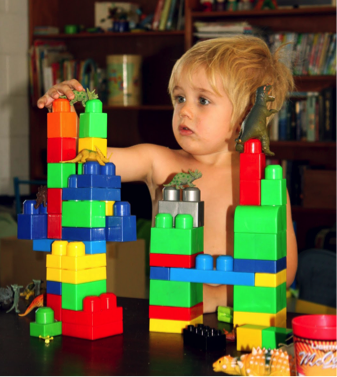
A teacher notices that a toddler plays with dinosaurs for virtually of free play. The teacher follows the toddler's pb by going over and playing with the dinosaurs together. By following the toddler'southward lead and combining it with shared control, the teacher could intersperse PRT learning opportunities every bit they play with the dinosaurs.
Kickoff learners, or younger toddlers, working on developing communicative intent could be prompted to vocalize "dino" or point to the "dino" in order to take a turn playing with the dinosaur. A more than avant-garde learner, or older toddler, working on play skills such as cake building could exist prompted to build a tower together prior to letting a dinosaur knock over the tower.

b. Embed social interests and preferences
Identifying individualized, socially oriented reinforcers and embedding preferred social interaction within the delivery of natural reinforcement has been shown to improve social engagement and joint attending (Jones, Carr, & Feeley, 2006; Koegel, Vernon, & Koegel, 2009; Vernon, Koegel, Dauterman, & Stolen, 2012).

Why embed social activity interests and preferences?
These strategies may assistance increment social behaviors such as reciprocal social smiling, heart contact, social orientation toward a parent instead of toward an object, and articulation attention. Some researchers doubtable that early on challenges in social motivation are core to the development of ASD (Dawson, Webb, & McPartland, 2005).
PRT tin be used to increase social motivation early in an baby or toddler's development earlier secondary symptoms ascend (Dawson, 2009; Voos et al., 2013).
Preferred social activities:
- incorporate every bit activities more frequently in the child'due south mean solar day.
- embed within natural reinforcers.
- use every bit an idiosyncratic social reinforcer as a result for joint attending.
It is of import, especially for infants and immature toddlers, that rewarding social activities incorporate many of their PRT learning interactions. A rewarding social activity is an activity where another person, such as a parent, is a crucial component of the reward value associated with the activity. In other words, the reinforcer does not exist without the social date of the parent or practitioner with the toddler or babe.
Infant and Toddler Social Activities
- Being held and walking around together
- Peek-a-boo games
- Blowing on stomach to make empty-headed noises
- Singing songs/rhymes with sensory actions (i.e., "This Little Piggy," "Itsy Bitsy Spider," and "Patty cake")
- Jumping, bouncing ("Giddie-up horsie" on knee joint), swinging, spinning, and dancing together
- Going "night, night" games
- Fall downwards games
- Playing "airplane"
- Silly face games- such as, raspberry lips
- Light-headed noises/voices games (such as making fauna sounds; making silly "sneezes")
- Chase "I'1000 gonna get you!" games
- Tickle games
- Splashing water at each other
- Driving/pushing/pulling around in a wagon/sled
- Blowing bubbles
- Bravado upwardly balloons and letting them get
- Juggling assurance in the air
It may be the instance that an infant or toddler's involvement in social activities is restricted, minimal, and fleeting. Combining this step with Interspersing Maintenance and Conquering, also every bit the other motivational components, tin can help increase the duration and quality of appointment in social activities. Researchers and clinicians at the UCSB Koegel Autism Center have developed Five Steps for Building Early Developing Date in Social Activities. These are described below:
Five Steps for Building Early Developing Date in Social Activities
i. Identify social activities
Follow the infant's lead and identify a variety of social activities in which s/he will engage – even if briefly! Parents and practitioners may accept to do some enticing and "try outs" of the dissimilar social activities in different contexts. Be persistent and look for even fleeting moments of centre contact and positive affect, such as cursory smiles. Categorize the social routines co-ordinate to neutral or preferred activities. Parents may have different levels of preferred activities, such as, "one-time preferred" versus "oftentimes preferred." Parents can plough the list into a preference hierarchy of social activities.
2. Incorporate preferred (maintenance) social activities only, and apace vary them
Begin with strengths! Start by incorporating the nearly preferred social activities in which the infant will commonly appoint. Spend 10 seconds on each preferred social activity before varying the task to the next activity. Do this for approximately five minutes or less. Start with smaller amounts of time and increase gradually. End each social activeness on "a positive notation," when interest levels are nevertheless high. Practise not expect until the baby or toddler has indicated lack of interest before varying the social activeness.
three. Add a neutral (acquisition) social activity
Inside the next few times a parent provides these opportunities, they should attempt to innovate the next social activeness on the hierarchy list and add together information technology to the activity repertoire. Intersperse information technology among the preferred maintenance social activity. For instance, engage in the social action the infant/toddler is most likely to happily engage in (maintenance), and so vary the task by introducing the neutral conquering activity while they are all the same engaged. Brand the conquering social activity very brief at first.
four. Reinforce and take frequent breaks
Reinforce the infant or toddler by rapidly going dorsum to the preferred maintenance social activity. Take a pause afterward the designated amount of time for staying socially engaged in social activities (eastward.g., 5 minutes total). Retrieve, these simple social interactions could be taxing on an infant or young toddler. Endeavour to choose social breaks, such equally being carried effectually past an developed, but make certain it is a break!
5. Gradually increase
Gradually increase the duration of each social activity, the overall corporeality of time socially engaged (east.g., from 5 minutes to 7 minutes), likewise every bit the number of social activities added to the baby or toddler's preferred social activities.
Incorporate into PRT opportunities at a later fourth dimension. As the infant or toddler develops, embed the preferred social interactions into natural reinforcers for other PRT opportunities. For example, as the babe or toddler begins to prefer the tickle activity, intersperse prompts to vocalize "tickle" and naturally reinforce attempts past tickling the infant or toddler.
(Koegel, Singh, Koegel, Hollingsworth, & Bradshaw, 2013)
Run across Natural Reinforcers, for more on embedding social activities in natural reinforcers and using individualized social reinforcers.
EXAMPLE
A mom observes that her 9-calendar month-one-time rarely socially smiles, however sometimes likes existence held and walked effectually, having her toes nibbled, and having her stomach diddled. Her infant, though, will but play peek-a-boo for very fleeting moments and volition almost never socially smile during the routine. Mom wants to increase her infant's social date during this peek-a-boo activity. Mom begins the social play routines at a time she has plant her babe to most likely respond with heart contact and smiles, which happens to exist correct after bath time. Mom speedily varies between nibbling on her toes and blowing her stomach, and after a few minutes (before her girl disengages), mom picks her up and walks around the room together. Mom continues this all week.
After a few days her infant is consistently giving eye contact and socially grin, and sometimes laughing during these brief social routines. Mom and so decides to add peek-a-boo to the routine. After going through the maintenance social activities, mom begins playing peek-a-boo and every bit shortly equally her infant responds by looking at her with a smile, mom smiles dorsum enthusiastically and goes dorsum to blowing her tummy. A couple days later, mom mixes in ii peek-a-boos considering her daughter is spending more time happily and socially engaged during the ten seconds of peek-a-boo. This interaction becomes a office of their bath time routine. Soon her infant is anticipating the peek-a-boo game subsequently her bath. Afterward in her kid's programming, when she is 13 months and highly prefers peek-a-boo, her mom prompts her to say, "boo," in social club to initiate playing peek-a-boo together.
c. Incorporate interests and preferences
Yous may too contain a toddler'south interests into established or new activities, tasks, and routines. For instance, if the toddler has a perseverative or strong interest in dinosaurs, during the play dough center, the dinosaur cookie cutters could be used to motivate the toddler to play functionally with the play dough. A toddler working on receptive linguistic communication skills and functional play could be told to either ringlet the play dough or pat down the play dough. Making dinosaurs with the dinosaur cookie cutters naturally reinforces the toddler's attempts. During book time, books with dinosaurs could exist read together and PRT opportunities could be interspersed during the engagement (e.g., asking the toddler, "What do yous come across?" and then naturally reinforcing them by turning the page to encounter more dinosaurs).
EXAMPLE
A mom wants her older toddler to launder her hands, just often refuses and tantrums. Mom decides to incorporate her interests, including bubbles and letters. Mom fills up the sink and makes bubbles and puts plastic messages in the sink. Every bit her toddler begins to accept going to the sink to wash her easily, mom gradually fades out the bubbles and letters.
Arrange the toddler's environment with child-preferred, developmentally appropriate objects and activities. During free time a parent could lay out an array of art materials for a toddler who enjoys arts and crafts.
d. Provide choices
Incorporate selection-making opportunities into naturally occurring routines, activities, and task demands or instructions throughout the day. Choices enhance date, increment rates of learning, and decrease challenging behavior. Choices also provide outstanding advice and linguistic communication development opportunities.
Case
A brawl, a clear box of blocks, a shape sorter, and a bottle of bubbles can all be placed on a high shelf, in sight, but out of reach. When the toddler points to the bottle of bubbling and says an approximation of "bubbles," the parent can say, "accident bubbles!" (a recast) and take them downward and commencement to open them with the child (the natural reinforcer). The toddler had the choice of several different objects, each providing an equal opportunity to practice communicating through requesting items. For an older toddler with more linguistic communication skills, yous might ask, "Do you desire to play more ball or go on the slide?"
Choices are also provided within adult-directed instructions, providing a level of shared control (see Shared Control) that improves a toddler'southward response to adult management. A variety of choices tin exist offered in terms of: what / which (what to exercise, which ane to play), where (to do the task), with whom (to play), how (the action should be washed), and when (to do the activity). 
Case
During a transition away from a preferred activity such as trampoline, a practitioner could inquire the toddler if she wants to run inside or walk to the swing, or if she wants to bound 5 more than times or ten more times before going within for snack. If it is time to work on fine motor skills and scribbling with crayons, the toddler could choose which colour crayon or newspaper to utilize.
Allow toddlers to select materials, topics, and toys during education activities. This may be particularly important when introducing new skills and tasks. Using toys, items, and activities that individual toddlers prefer may increment their motivation to participate and thus may increase the likelihood that they will rapidly acquire target skills and employ them spontaneously. For example, when a toddler chooses to use colored Legos instead of wooden blocks, he may exist more motivated to consummate a tower building task during fine motor center.
Examples of Incorporating Perseverative Interests to Increase Joint Attention | |||
|---|---|---|---|
| Perseverative Interest | Puzzle | Pretend Figurines | Books |
| Numbers | Number puzzle | Draw numbers or put number stickers on existing figurines | Counting and number books |
| Opening and closing various doors | Wooden board with dissimilar doors and latches to open up | A doll house or undiscriminating set with various doors | An interactive volume that has flaps hiding pictures and text (flaps that can be open and closed) |
| Animals | Zoo creature puzzle | Undiscriminating play gear up, animal figurines | Zoo books |
| Vehicles | Vehicle puzzle | Miniature vehicles with ramps/garage | Car books |
Pace 2.iii Establish motivation through shared command and turn taking
Creating shared control is an important step in establishing the toddler's motivation to reply. Shared control likewise assists in obtaining the toddler'due south attending. The concept of shared command mostly has to practise with both the developed and child playing important roles in the learning interaction. Shared command also helps to set up, or establish, a situation where natural reinforcers can exist provided contingent on attempts at target behaviors (come across Natural Reinforcers). Sometimes this is chosen briefly "restricting admission" to a kid called item or activity.
Ways of creating shared command in society to increase a toddler'southward attending and establish a toddler's motivation to interact and try during the learning opportunity:
Take turns
Plow taking is a natural way to ready a contingency and provide appropriate models. Once parents and practitioners have established that the toddler is interested in engaging with a sure item or in a certain activeness in the moment, then they are set up to ready upwards shared control. By taking a turn, parents and practitioners are not only teaching the toddler plow taking, but also setting up an opportunity for some other learning interaction, whereby the toddler is given another turn contingent on an attempted response (encounter Natural Reinforcers). Appropriate models (east.g., play deportment and comments on play) are also provided on the parent or practitioner's turn.
Manage materials and "in-sight and out-of-reach"
Have child-preferred materials in a container or kept in-sight of the toddler, but out of their attain. The chosen materials are brought out one at a time and piece by piece. This allows for shared command of the materials. The adult controls the catamenia and commitment of the toddler chosen items and activities contingent on desired response attempts by the toddler. This environmental organization helps plant motivation throughout play or a daily routine.
Create (or look for) opportunities where the kid needs developed assistance
Parents and practitioners are skillful at knowing when a toddler needs assistance and may complete the assistance without expecting a response from the toddler. Instead, in PRT they create shared command and apply these times equally learning opportunities!
Interrupt a routine
Interrupt a routine and complete the routine contingent on a desired response by the toddler is another manner to constitute motivation through shared control. Instead of the toddler having full command over the routine, a practitioner and toddler share control of information technology. If possible, interruption should be natural and playful, versus abrupt and overly contrived.
Break up natural reinforcers and provide "bit-by-bit"
Break up learning stimuli and natural reinforcers, and provide simply a bit at a fourth dimension, thus allowing for more than opportunities to create those motivational shared control situations
Provide choices in selecting an activity and which parts of a task the toddler
might complete
Shared command learning interactions also involves providing choices in activities and tasks. For instance, although at first the toddler's interests volition be followed, they will probable be followed inside appropriate boundaries fix by the parent of practitioner. As seen in prior examples, the parent or practitioner also chooses what responses are expected of the toddler during PRT learning opportunities. Further, equally an older toddler progresses, information technology may exist the case that the parent or practicioner and the toddler have turns in choosing among preferred and neutral activities. Within a given chore demand, there also may be shared control over which parts of the task or routine will be completed by the toddler versus the parent or practitioner, or how the chore will be completed.
Step ii.4 Go the toddler's attending
Parents and practitioners should establish the toddler's attending earlier providing cues, prompts, questions, instructions, and/or choices (see Prompting Strategies). Strategies for gaining attending include: saying the toddler'due south name, tapping on their shoulder, making an enthusiastic sound or phrase, giving a quick tickle, making center contact, and/or arranging the surroundings to support shared control (run across Shared Control). Strategies for gaining a toddler's attending should also be varied over fourth dimension.
Individualization: Orienting cues and nonverbal toddlers
Some toddlers who are nonverbal may accept difficulty orienting and attending to the relevant cues in the learning interaction, such as, a verbal model of a word. In this example, constructive and individualized strategies for gaining child attention/orienting should be tried (Koegel, Shirotova, & Koegel, 2009).
Using individualized orienting cues only prior to providing the verbal model prompt could ameliorate the beginning learner's response to the exact model prompt, that is, faux of the verbal model.
EXAMPLE
A three-yr-one-time nonverbal toddler who had difficulty developing first words, oriented to and imitated the verbal model immediately later being asked to give a high-v.
Loftier-fives were found to consistently produce an orienting response from the three-year-one-time. The researchers thought that the loftier-five functioned to orient the kid to the relevant information: the adult'due south verbal model of the word.
Step 2.v Utilize clear, natural, and varied prompts
One time the toddler is attention, parents and practitioners employ cursory and articulate instructions. These instructional antecedents should mirror naturally occurring cues and prompts as much as possible.
EXAMPLE
When a toddler indicates he wants to turn the water on at the sink, a parent or practitioner tin teach the toddler to request to turn it on (when the toddler has not notwithstanding caused the word "h2o") by prompting the toddler simply with the verbal model, "water." In that location is no need to prompt with, "Say water." Besides, saying a long phrase, such as, "Okay, Logan, just say water!" is not an appropriate instructional antecedent for didactics first words with PRT.
The most unremarkably used PRT prompting strategies, or instructional antecedents, from nigh assistance to least assist, and from least independent to most independent, are:
- model prompts
- chioces
- open-ended questions or statements and
- time delays.
Model Prompts
The total model is used to prompt the kid to respond with an imitation of the model. In order to increase rapid independence, partial prompts tin can be used to fade total models.
Choices
Providing choices is another motivational process (see Step 2.two for more than on choices) and is an of import prompting strategy. Choices contain two models for the toddler to cull between and can prompt the toddler to imitate i of them (and not the other) and/or appoint in i of the response choices (and non the other). Careful and systematic didactics of choices is also useful for reducing immediate echolalia and indiscriminate choice making (eastward.g., the toddler simply repeats the last part of the choice). See Koegel and Lazebnik (2004, pp. 56 - 59) for elementary solutions for reducing immediate echolalia and increasing accurate choice making in exact children with autism.
Open-concluded questions or statements
Open-ended questions, such as Wh- questions tin be immediately faded into prompting strategies equally the toddler acquires various words or communicative acts. If a toddler already asks to go exterior by approximating the give-and-take "outside," a model prompt is not necessary. A choice, question, or fourth dimension delay will aid a toddler become more spontaneous with their communication. Example questions could be, "What do you lot want?" or "Where should we go?" or "What would you like to exercise?"
Exist careful providing too many close-ended questions that result in aye or no answers, unless this is a specific objective. These yes or no questions limit the toddler's chances of practicing more meaningful and varied verbal skills. You can also make open-ended statements that would prompt a different simply like argument or a question from the kid. For instance, upon taking the letter puzzle piece "A" from a container, you say, "I got A!," which provides a verbal cue for the toddler to say, "I got [ the alphabetic character the toddler picked ]!" when they take a alphabetic character on their turn. Similarly, you tin accept a letter and hibernate information technology in their hands, and say, "I got a letter!" as an opportunity for the kid to enquire, "What letter of the alphabet?"
Fourth dimension delays
Fourth dimension delay prompts involve minimal firsthand actions on the function of the parent or practitioner. Fourth dimension delays involve waiting for a brief period (eastward.g., 3-five seconds) prior to providing more assistance. For instance, if the toddler wants his male parent to gyre the ball back to her, and the male parent has been providing the model "ball" to prompt the asking, the father might instead pause and wait expectantly for a few seconds. If his toddler says "ball" independently during that suspension, the father should roll the brawl dorsum as he recasts, "roll brawl!" If his toddler does not respond, so the male parent can provide more assistance by: modeling the word, request if he should "roll ball or roll car," (while showing each pick) or simply asking her what he should ringlet, "What should I roll?"
Stride 2.6 Immediately reinforce the toddler's attempts
a) Reinforce the toddler's attempts at responding that are clear, unambiguous, and goal-directed.
Reinforcement of response attempts is a consequence PRT component brecause it happens after the toddler provides a response. Reinforce the toddler's attempts that are purposeful approximations of the targeted response. By reinforcing attempts, in add-on to correct responses, yous increase the likelihood that children will engage in hereafter attempts as they feel more success and positive reinforcement for appropriate trying. Learning to talk, play, and socialize tin be hard work, and reinforcing attempts may keep toddlers willing to engage in the "hard work."
Instance
A nonverbal 18-calendar month old who is starting to make erbal communicative intent, reaches for a book and says, "Ooo!"
Although this is not the targeted response, such equally, "volume", the parent immediately reinforces the attempt by saying "book!" while handing the volume to the toddler.
Doing then naturally reinforces the attempted vocalization and re-models (recasts) the target response.
b) Provide direct reinforcement immediately subsequently a goal-directed endeavor
Provide direct reinforcement immediately after and contingent on a goal-directed attempt. Pay careful attention to providing reinforcement only after a correct response or endeavor by the toddler.
Case
A practitioner immediately continues tickles (the natural reinforcement) for an baby who attempts social engagement past giving brief middle contact and socially smiling.
Step 2.7 Use directly or natural reinforcers and so transition to the next opportunity
A natural reinforcer is defined every bit a reinforcer that has a direct human relationship to the kid'south behavior and the job. The reinforcer, a consequence, is logically related to a chain of antecedents and responses.
Example
A toddler may indicate involvement in bravado bubbles. When he blows the bubbles, the bubbles created are the natural reinforcer for this behavior (i.e., blowing the bubbles). Likewise, if the toddler requests the bubbles to exist blown by vocalizing, "bah," the natural reinforcer would be for the parent to open up the bubbling and blow them (or assist the child blow them).
a) Identify materials and activities that can be used to address a toddler'due south
objective during a teaching opportunity
This is done in conjunction with following the toddler's pb, providing choices, and establishing motivation through shared control. The delivery of the natural reinforcer is direct tied to these PRT components.
For example, a parent or practitioner presents a kid with a clear jar with a lid that contains raisins. The toddler will most likely try to open the jar and so await to the practitioner for aid. After the toddler attempts to utilize a target phrase either independently or through clear prompting, such as "help!" or "open raisins", the practitioner immediately provides access to the natural reinforcer within the jar.
In dissimilarity to PRT opportunities that use natural reinforcers, the parent could have prompted the toddler to say "open" in reference to an empty jar, then provide a raisin sitting on a plate on the table.
b) Parents and practitioners implement a learning activity that is functionally
and directly related to the toddler'due south objectives
If a toddler'due south target behavior is to ask for a break instead of escaping demands past screaming, when the toddler initiates a request for a break by proverb, "break" or pointing to a "break card," the practitioner immediately responds past assuasive the toddler to have a minute of neutral free fourth dimension while staying in the same area. However, if the teacher instructed the toddler to complete another chore before reinforcing her initiated response, "break," so this would not exist an case of a directly related, functional reinforcer.
Note: Although non a natural reinforcer, this would be an appropriate strategy for thinning reinforcement in guild to increase desired task engagement over time.
c) Embed social interaction into natural reinforcers
Follow the infant and toddler's lead in society to identify reinforcing social activities that can be increasingly incorporated into routines for infants and toddlers. Research has also identified that embedding preferred social activity into the delivery of the reinforcer is effective in improving synchronous toddler and parent appointment, eye contact, and improved toddler and parent affect (Vernon et al., 2012).
Potential Ways to Embed Motivating Social Activity into Commitment of Natural Reinforcers | ||
|---|---|---|
| Activity & child response (prompted or spontaneous) | Natural reinforcers without social activity | Natural reinforcers with embedded social action |
| Jumping on trampoline Toddler requests, "jump" | Toddler gets to jump on trampoline | Developed jumps with the toddler |
| Splashing in the bath Toddler requests, "splash" | Toddler gets to splash water | Adult splashes the toddler, toddler splashes the developed |
| Playing cars Toddler says, "crash cars" | Toddler is given 2 cars to crash into each other | Adult crashes a toy car into the toddler's toy car |
| Sliding on slide Toddler says, "slide" | Toddler gets to go downwards the slide | Adult and the toddler go downwards the slide together |
| Music Toddler requests a vocal | Toddler listens to the song on the computer | Adult sings the songs to the toddler |
| Playing with dinosaurs Toddler communicates "dino" | Toddler is given a toy dinosaur | Adult "roars" the dinosaur and makes it "stomp" or "fly" over to the toddler |
d) Reinforce articulation attention and social comments with individualized social
reinforcers
Joint attention is a triadic social experience between a child, detail or result, and an adult. Infants as immature equally viii-months former engage in joint attention in gild to share with parents their affect (involvement, happiness, enthusiasm) associated with an event or item. The natural reinforcers for articulation attention acts should be distinct from the natural reinforcers associated with requesting items and events, as well as other behavior regulation functions (Jones, Carr, & Feeley, 2006). Provide the enjoyable social reinforcers right later on joint attending, such as pointing at a picture or saying a comment.
These reinforcers are:
(1) individually identified (and frequently unique) for each toddler and
(ii) they are social.
They are social because the rewarding aspect of the action centers effectually interaction with the adult.
Review examples below of potential ways to use social reinforcers when straight targeting joint attending in infants and toddlers. In the examples, the toddler'due south social reinforcers include tickles, exaggerated noises or voices, and jumping with an adult.
Using Social Reinforcers every bit Natural Reinforcers forTargeting Socially Motivated Articulation Attention Behaviors | ||
|---|---|---|
| Activity & child response (prompted or spontaneous) | Case not-social reinforcers for: joint attending used for requesting objects | Example of Idiosyncratic natural social reinforcers for: joint attending used for socially sharing affect |
| Walking at the zoo Toddler points at a monkey and looks back at mom | TToddler allowed to become look at the monkey | Mom says, "Yes, a monkey!" gives the toddler "monkey tickles;" mom and child make monkey noises together |
| Reading a book Toddler brings the train book over to mom, gives heart contact, and says, "trains!" | Mom gives the train volume and/or reads the book to the toddler | Mom exclaims, "Choo! Choo!" and pretends to be a train while making railroad train sounds |
| Playing Pop Up Pirate™ Toddler points at the pirate, looks at mom, and comments, "it popped!" | Mom gives the toddler more pirate swords to go along playing the game | Mom says, "The pirate popped!" and has the toddler on her lap, and bounces him every bit if to make him "pop up" |
| Doing a alphabetic character puzzle Toddler finds the letter "V," picks it up, holds information technology out to show Dad, and smiles at him. | Mom gives the puzzle lath to the toddler so they may put in the letter "V" | Dad tickles the child while making a "Vvv" sound and says, "Y'all found V!" |
| Playing Cariboo™ Toddler opens a door with the key, points down, looks upward at the practitioner, smiles, and exclaims, "pink ball!" | Toddler may take out the pink brawl and continue with the chosen game | The practitioner juggles the brawl while making silly noises, and says, "the pinkish ball!" |
Step 2.8 Target pivotal expanse of initiations
Using Kid-Initiated Strategies: Teaching Question Asking
Toddlers with ASD can successfully be motivated and taught to ask a variety of Wh- questions (Koegel, Bradshaw, Ashbaugh, & Koegel, 2013). Question asking is particularly relevant to initiations because it shifts the initiation of the learning interaction from the adult to the child. Often times, adults inquire all the questions and beginning most of the learning interactions. By request questions independently, toddlers initiate interactions that facilitate information gathering and farther learning. Teaching question asking also expands the purposes for which children might use advice.
The questions described in this section are in developmental sequence.
Step 2.9 Target the toddler'due south responses to multiple cues
Increase the toddler's responses to multiple cues
Using PRT motivational opportunities, teach and motivate older toddlers and preschoolers with ASD to answer to multiple cues. Cues, also chosen properties or attributes, are taught incrementally until toddlers reply to more than complex tasks. Teaching multiple cues may non be appropriate for younger toddlers and are associated with advancing linguistic communication and conceptual skills.
Identify multiple cues and gather materials with multiple cues. Parents and practitioners identify a variety of cues (backdrop or attributes) that are associated with the stimulus (east.g., toy) or activity and that can be used during a PRT learning opportunity.
Add together some other cue. As the older toddler advances, parents and practitioners provide at least two cues (e.g., overemphasizing feature of object, color, size, type of object, location of object) and so that their toddler will begin to employ the target skill in response to more than than 1 cue.
Increase complexity. Parents and practitioners gradually increment the number of cues associated with a detail object, textile, or toy then that the learner can respond to a variety of stimuli
Schedule reinforcement
Parents and practitioners as well use different schedules of reinforcement to teach an older toddler with ASD to respond to multiple cues.
Identify natural reinforcers. Numerous natural reinforcers that can be used to increment a toddler's motivation to use the target skill of responding to multiple cues. For instance, a practitioner might discover that the toddler enjoys playing games on the iPad, including a airship popping game.
Begin with fixed ratio, continuous schedule (i.e., FR1). Provide reinforcement for every endeavour to use the target skill successfully (continuous schedule). As an example, a toddler is immune to "popular a balloon" (natural reinforcer) on an iPad screen every time she answers what color or shape the airship is.
Progress to variable ratio, intermittent schedule (e.1000., VR2). It is important to progress to intermittent reinforcement schedules throughout an older toddler's PRT programming. In a continuous schedule of reinforcement, you lot would permit the toddler to pop the balloons on the iPad game every fourth dimension she responds to a question about the color or shape of the balloons she wants to pop. With a variable ratio schedule of reinforcement, VR2, the toddler responds with expert attempts for an average of 2 questions prior to popping the balloons in the game.
Step two.10 Target self-regulation
Use PRT motivational opportunities to teach and motivate children with ASD to engage in appropriate behaviors that foster early developing cocky-regulation skills. Implement self-management differently for older children. Refer to the National Professional Evolution Eye on ASD for more information on Self-Management.
Beneath are strategies that are integral aspects of early PRT programs and designed to teach the toddler to regulate his/her behavior through appropriate communication rather than challenging behaviors.
Teaching "all washed" and "pause" to end activity and transition
-
Parents and practitioners teach the toddler to terminate an activity and transition by prompting them to communicate, "all done" prior to leaving an activity or areas. This can replace challenging behavior related to frustration and boredom that results in the toddler escaping the task. Or it may supersede a toddler's fleeting engagement as they bounce around from one action to another.
-
When the toddler communicates "all washed," naturally reinforce the toddler by allowing them to leave the area/activity.
-
As the toddler learns to communicate "all done," parents and practitioners add a clean up component that is cursory at beginning and then gradually more involved. Clean-up occurs prior to assuasive the toddler to get out the child-called activity.
-
When toddlers are happy to clean up, parents and practitioners target diverse skills during clean upwards and it may be the case that the toddler re-engages in the activity during make clean up. Oftentimes this leads to increasing a toddler's duration engaged in the aforementioned kid-chosen activeness.
-
As the toddler progresses, toddlers learn to cease the action past initiating "all done," cleaning up, and and so initiating play with a new action with an developed (e.g., "come play…!"), prior to engaging in the new kid-chosen action.
-
Asking for a "intermission" is taught in a similar way, however breaks are express to a brief termination in the activity followed by re-engagement in the same action.
Teaching "help" to asking aid
Educational activity children to request help tin can decrease challenging behaviors associated with frustration, avoidance of tasks, and escaping tasks. It is of import to exist conscientious of reinforcing challenging behavior past helping a toddler afterwards they but engaged in a tantrum or similar challenging behavior. Prior to providing aid, parents and practitioners prompt the toddler to communicate, "assist," using an appropriate mode of advice. This teaches the toddler to regulate his/her behavior through appropriate communication.
Replace challenging behavior with Functional Commuication Training (FCT)
PRT can be used to teach appropriate, functionally equivalent (but more efficient) communicative replacement behaviors. During PRT interactions, proactively replace challenging behavior by prompting and differentially reinforcing appropriate communication while placing challenging behavior on extinction (i.due east., withdrawing the maintaining consequences when challenging behavior is exhibited.
PRT components likewise serve as ancestor (preventative) procedures past maintaining a toddler'due south motivation and making challenging behaviors less relevant or necessary to the toddler.
Replace challenging behaviors that serve the following functions:
- obtain items or activities
- obtain attention
- avoid or escape task demands and attending
This strategy relies on the adult correctly identifying the function of the challenging behavior, so the parent or practitioner may need to take information through a functional behavior cess (FBA). Notwithstanding, clear functions can be actively replaced in the moment across multiple situations. Teaching the toddler to communicate to get his/her needs met is an of import early developing self-regulation skill that tin be fostered in toddlers. Differentially reinforcing functional communication at a young age could play an important role in the prevention of more serious challenging behavior from developing later in childhood. Combining FCT with the motivational components of PRT is an effective way to decrease interfering challenging beliefs and go along children happy and learning during intervention and interaction.
Ameliorate tolerance for delays to reinforcement. For functional communicative acts, information technology is also of import to teacher older toddlers and more than advanced learners to tolerate delays to reinforcement. The amount of time before receiving reinforcement for maintenance requests by the toddler tin be gradually increased and the reinforcer can be provided contingent on appropriate waiting during the delay (eastward.chiliad., absence of challenging behavior). Parents and practitioners introduce reinforcement schedule thinning by intermittently reinforcing maintenance behaviors.
Annotation: There are many positive behavior supports that should be integrated into a toddler'south intervention equally needed. Other of import techniques for addressing challenging behaviors in toddlers might include systematic desensitization, various ancestor manipulations, differential reinforcement of other behavior, additional applications of differential reinforcement of culling behavior, and instructions based on the Premack principle.
Using Visual Activity Schedules and Systems
Education toddlers to apply a visual schedule or activity system is another way to foster early on developing self-regulation skills.
Practice Scenarios: Implementing PRT
After reviewing instructions above, select a Scenario.
Nosotros recommend that yous proceed with the same Scenario setting throughout the module.


Review the Troubleshooting Tips if y'all are having trouble viewing.
Knowledge Check

Question:
Which of these represents a motivational opportunity for a nonverbal 17-month old toddler?
Select one of the following:
- A nonverbal child reaches for the low-cal switch to turn on and off the light. A practitioner stops the child and redirects the child to vocalize for a ball he is property. The child does non respond or endeavour to obtain the brawl and instead goes dorsum over to the light and turns information technology off.
- When a mom sees her nonverbal kid playing with a brawl ramp game, she puts downward the book she was going to read to him and goes over to the ball ramp toy. Mom repeatedly says the discussion "ball" while trying to get her son'south attention as her son continues to put the balls down the ramp.
- Dad notices his two-year-old nonverbal son keeps going within the laundry basket and is avoiding playing cars with him. Dad goes over to the basket and picks information technology upward and puts it down with his son within. His son smiles and nonverbally indicates he wants more. Before picking it upwards, Dad gets his son'south attention and models "upwards," and picks it upward and puts information technology dorsum down a couple of times in a row. The child yet indicates he wants to get up again, merely this fourth dimension dad models, "up" and waits for the child to attempt to vocalize "up" before he lifts him upwardly. After 3 seconds, the kid finally says, "aah," and dad immediately and enthusiastically lifts up the laundry handbasket while clearly and enthusiastically recasting, "Upwardly!"
- A practitioner selects multiple flashcards of items she knows the three-twelvemonth-onetime toddler prefers. She sits with her on the carpeting in the playroom (the natural environment) and then provides ten trials in a row asking the kid, "What's this?" for each card. The child gets to briefly play with either a squishy ball or spin toy (determined through a brief reinforcer assessment) for correct responses.
PIVOTAL AREA: SELF-INITIATIONS
Question:
What are some potential collateral effects of cocky-initiations?
Question:
Which intervention uses an appropriate natural reinforcer for teaching question-asking?
Select one of the following:
- When the toddler asks where an item is, you go get the detail and give it to the toddler
- When a toddler asks "Whose is it?" referring to a toy, yous say "Mine!" and accept the toy
- When the toddler asks where an item is, you tell the toddler the location of the item and assist/prompt to brand sure they tin can obtain the item from the location quickly
- When a toddler asks, "What's that?" most an item on the table, you praise the question and provide an M&K and then say, "Y'all know what that is! What is it?"
PIVOTAL Expanse: RESPONDING TO MULTIPLE CUES
Question:
An older toddler enjoys playing with wooden puzzles. Which of these examples of learning materials provide an ideal situation for teaching multiple cues?
Cull one of the following:
- flashcards with all the dissimilar combinations of colors, shapes, and sizes
- a puzzle that has i blue square, one yellow triangle, and 1 ruddy circle
- a puzzle with ane blue square, 1 red foursquare, ane blue circle, and one cerise circle
- any of the above
Is this argument True or Simulated?
Teaching multiple cues is a beginning level PRT intervention target for nonverbal toddlers with autism.
Source: https://asdtoddler.fpg.unc.edu/book/export/html/381.html
0 Response to "what can be used to determine existing nonsocial and social reinforcers"
Post a Comment